Suspension of old growth forest logging but other logging continues
The government has suspended plans for the Natural Resources Commission to re-map old-growth coastal state forests. The mapping by remote sensing technology was to have been used to identify forest that might still be available for logging. The remote sensing technology cannot be applied accurately after the burning of so many hectares of forest canopy last summer. The funds for the project have been redirected to a Forest Monitoring and Improvement Program.
The Nature Conservation Council has campaigned for the end of logging in old-growth forests altogether and has welcomed the suspension. However, logging has been resumed in some state forests in the north that include koala habitat. Forests on private land are still not adequately protected.
New national park in western NSW
A new conservation area will be created in far north western NSW following the purchase of 153,415 ha of private land about 60 km from Tibooburra.
The land contains important ecosystems, particularly wetlands fed by the Bulloo River. It is not part of the Murray Darling Basin or the Lake Eyre Basin. The wetlands support at least 27 threatened species. The area is rich in Indigenous and European history.
As feared by the residents of West Pennant Hills and environment groups the NSW government has ignored the more than 4,000 resident and local council objections to Mirvac’s plans for the development of 600 dwellings on the former IBM corporate headquarters next door to the Cumberland State Forest. The plans are on the list of projects to be ‘fast-tracked’ in the interests of creating jobs to speed up recovery after the COVID-19 slowdown. A short-term gain of employment will result in the long-term destruction of beautiful, tall mature forest and the creation of more traffic jams and infrastructure shortfalls. The site could have been retained for commercial or education uses and provided many more jobs for the local area.
The approval applies to the rezoning required from that of a business park in order for the development to proceed. Some modifications have been made to the plans that were described in STEP Matters, Issue 201.
There has been some recognition of community concerns and comments by the Environment, Energy and Science Group of the Department of Planning (EES, formerly OEH). Some modifications of the proposal are outlined below. Many questions and concerns still remain in addition to the overall concern about over-development of the Cherrybrook area and the destruction of a large number of mature trees that surround the existing IBM buildings.
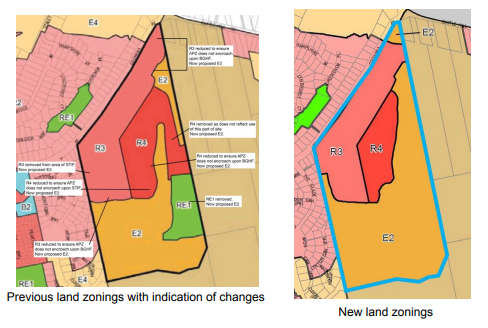
The area of the residential footprint will be reduced and the associated bushfire Asset Protection Zones (APZs) so they do not encroach on the BGHF and STIF critically endangered ecological communities. The proposed APZs would have resulted in the modification of multiple patches of BGHF and STIF totalling approximately 1 hectare. The number of dwellings remains at up to 600 so, no doubt, there will more high rise and less medium density apartments. The tiny 86 m2 terraces remain.
A 100 m buffer distance from residential buildings is required near nest trees in accordance with guidelines for conserving Powerful Owl habitat.
EES has commented on the need for prohibition of free-ranging cats in the development and that dogs would need to be under control at all times but especially near bushland areas. This would require fencing critically endangered ecological communities. How can these requirements be enforced? We have generally observed that dog owners let their dogs off the leash as soon as they think no one is looking or they feign ignorance of the requirement. Will fencing inhibit the normal movement of native species for foraging and nesting? This suggestion requires a lot more investigation!
The area zoned as E2, environmental conservation, will increase to 15 ha because of the change in the residential footprint and removal of the recreation zone. It is proposed that 9 ha of the E2 zone be managed by Forestry NSW as part of Cumberland State Forest. Will the funding be increased for management of this area?
The public recreation area, that was to be zoned as RE1 with a synthetic turf soccer field and lighting, has been removed in recognition of the impact the lighting and noise would have had on the Powerful Owls nesting and foraging needs. It will then be part of the E2 zone and this area, currently mostly mown grass, will be rehabilitated and revegetated with local native species. This area may include a kiosk or café with a maximum area of 50 m2.
The other E2 zone in the north that currently includes a car park could include a private recreation facility under community title subdivision, possibly indoors, subject to council consent. The public recreation facilities that were to be funded by Mirvac have gone.
EES recommended the existing pathways/walking trails be closed and revegetated and the number of pathways/walking trails within the ‘bushland edge’ and close to the Powerful Owl nesting sites are minimised. Further, EES recommended the new pathways/walking trails be located outside the bushland reserve and constructed of appropriate materials to minimise impacts on biodiversity. It is noted the walking trails are in the forested areas proposed to be dedicated to Forestry NSW and will be subject to a future plan of management.
Introduce a local design excellence provision for the residential areas. So what was the quality of the design going to be before?
What happens next?
The change in zoning has been forced through via this fast tracking process but the detailed layout and design of the residential buildings as well as other details of the land management still has to be approved by Hills Council. There will still be opportunities to make submissions on the next stage of the planning process. No doubt there will be a great deal of community interest.
The process of partially filling in the void that was Hornsby Quarry using spoil from the excavation of the North Connex road tunnel has been completed. Hornsby Council is now planning the next stage to create a recreation area that comprises Old Man’s Valley below the swimming pool, the Quarry and its surrounding area.
Some of the steep sides of the Quarry, particularly the northern side, are unstable and could collapse in a major rainfall event so rehabilitation works are required. Reshaping of the North Connex fill is proposed, as well as other spoil mounds within the site to allow future development of the quarry into a parkland for community use. These works have to go through a Development Application (DA) process including consideration of public submissions.
Hornsby Council has undertaken public consultation using public displays of the plans and put documents on exhibition. There are futuristic illustrations of the potential use of the site but this level of detail will be in the next stage of consultation.
On 6 May the Sydney North Planning Panel conducted a hearing into Hornsby Council’s DA for the works of Hornsby Quarry. Some individuals and community groups made submissions explaining their serious concerns about some aspects of the proposed works.
STEP, Protect your Suburban Environment (PYSE) and the Powerful Owl Coalition’s submissions drew attention to shortcomings revealed in some key documents.
The agreement document for a biodiversity offsets package was not available. It was totally unclear how biodiversity offsets under the Biodiversity Conservation Trust were applicable to the project.
A preliminary Vegetation Management Plan was provided but lacked the detail required for works on such a large and diverse site. Its link with the offsets package was also missing.
How the Blue Gum High Forest Save Our Species Priority Management Sites in the south western side of the site will be affected by the works.
Representatives from three geological societies made several submissions about the lack of recognition of the scientific significance of the volcanic diatreme rockface that is exposed by the quarry excavation. The outcomes of the final filling and landscape works on the floor of the quarry were not explained so it is not clear how much of the rock face would remain visible.
Panel decision
The people who had made submissions were delighted with the result. The Panel noted that several key issues of significant public interest were unresolved, and the development’s conditions did not provide necessary certainty of the outcomes for the Panel or for the public.
The Panel deferred the application so that the following processes can be completed:
Provide detail of the Biodiversity Offsets Package, Vegetation Management Plan and Habitat Creation and Enhancement Plans and submit these documents for public exhibition.
Submit a plan for public consultation defining and managing a buffer zone during the rehabilitation works around the Powerful Owl breeding pair’s roosting tree.
The information about extent of the volcanic diatreme rock face exposure when the filling and creation of the lake and wetland in front of the face have been completed.
Another process of consultation will occur when the required documents are completed.
A subsequent visit by Geological Society of Australia members with council officers provided an indication that there is likely to be more of the diatreme rock face exposed, not less. So good news.
The Coalition government just does not get it! Scott Morrison has stated in relation to the COVID-19 response that:
What we do in the next five years will determine the next thirty.
With the need to boost the economy and respond to the climate change risks demonstrated by ‘black summer’, one would think that climate change policies that will set a pathway to zero emissions by 2050 would be front of mind. We need long-term job creating strategies that demonstrate a clear trajectory towards a goal matching our Paris agreement commitments.
There are three reports and consultations over the past three months all of which have been dominated by fossil fuel industry interests:
Andy King, former Origin Energy CEO, was appointed last October to produce a review into new low cost sources of emissions reduction. Industry was consulted but not the general public or not-for-profit groups. Most of the recommendations in the report released in May have been accepted.
A consultation paper on a technology roadmap was released with over 140 technologies listed that could potentially be supported by government. Submissions closed on 21 June.
The National COVID-19 Coordination Commission (NCCC) led by gas company executive Nev Power, has been tasked with coming up with plans to revitalise the economy after the coronavirus shutdown.
All these actions are geared to allowing the market to control the implementation of the changes with some government support. Therefore, there is no overriding mechanism to ensure that Australia can be on a track that will lead to the goal of zero emissions by 2050. This goal can only be achieved if the fossil fuelled electricity generation is closed down progressively and replaced by renewable energy and storage mechanisms. Major changes are needed to other major sectors such as transport. The demand side of the equation that would reduce energy use needs to be addressed in a structured way.
It is clear that moving away from fossil fuels is not going to be actively managed. It will be up to consumers and business to take the initiative. The level of frustration of all sectors of the community was demonstrated in May when a cross section of peak organisations representing business, unions and charities sent a letter to the cabinet, energy ministers and the NCCC calling for rebuilding of a sustainable economy including measures to cut emissions and accelerate a transition to clean energy across all regions and economic sectors, and recommend a focus on fixing inefficient homes and commercial buildings.
Instead government rhetoric is emphasising:
carbon capture and storage
hydrogen produced from fossil fuels
gas as an interim energy source for electricity and manufacturing
Carbon capture and storage (CCS)
The King report recommended that a new abatement category be created under the Emissions Reduction Fund (ERF) for carbon capture and storage. The ERF has thus far been focussing on carbon farming and projects that increase energy efficiency. Australian governments have already spent over a billion dollars into carbon capture projects and technologies but there has been virtually nothing to show for it. Even if it works – which it very rarely does – CCS is extremely expensive and cannot deliver zero emissions. It cannot compete with the reducing cost of wind and solar. CCS paired with fossil fuels (so called ‘clean coal’) is simply an attempt to prolong the life of ageing, polluting fossil fuels in our energy system.
Gas
A draft report from the NCCC recommended that billions of public dollars be spent on increasing gas use by building new gas pipelines and underwriting of supply projects. They called for scrapping of state bans on coal seam gas as well as ‘green and red tape’ on gas development, including a relaxation of Australian standards for equipment used in gas infrastructure and a loosening of environmental regulations and approval processes under the EPBC Act.
The use of gas may be less carbon intensive for electricity generation but the production of gas is another matter. Fugitive emissions from the extraction, processing and export of gas (the liquification process) have been the main driver behind Australia’s emissions staying so high. A large part of the gas industry is geared to exports where prices are very volatile. The Climate Council has reported in detail on the reasons to steer clear of gas expansion.
The fracking process to produce coal seam gas is a major concern as it uses vast amounts of water, mostly drawn from the Great Artesian Basin, and converts it into similar amounts of salty water that may leach into groundwater, farmland and ecosystems. The Santos Pilliga Forest project is a prime example.
The use of gas for electricity generation instead of coal does not reduce emissions significantly compared with renewable sources, even with battery backup. Investing further in gas risks locking in huge investment losses, stranded assets and environmental harm.
Hydrogen
When the term ‘hydrogen’ is used in the energy sector, it refers to a simple molecule of two hydrogen atoms: H2. Creating hydrogen uses a lot of energy, and splitting it apart releases that energy again. This means that generating hydrogen, then using it, works a little like charging and discharging a battery.
While hydrogen is unlikely to outperform a conventional battery in the near future, there is huge potential for hydrogen to replace fossil fuels in areas that are difficult or impossible to address in other ways, like steel-making and long-range transport. Hydrogen can be used in many other sectors as well, from fertiliser production to simple energy storage.
Hydrogen can be created via a number of different methods. In the near future the most feasible means is using gas. Just one type of hydrogen – so-called ‘green hydrogen’ – which is hydrogen generated through renewable energy, is capable of playing a role in our zero emissions future.
Hydrogen shows great promise for low carbon industrial development and Australia’s energy exports but it will take time for the technology to be developed.
Documentary maker Michael Moore’s latest offering, Planet of the Humans, rightly argues that infinite growth on a finite planet is 'suicide'. But the film’s bogus claims threaten to overshadow that message.
Planet of the Humans is directed and narrated by longtime Moore collaborator Jeff Gibbs. It makes particularly contentious claims about solar, wind and biomass (organic material which can be burnt for energy). Some claims are valid. Some are out of date, and some are just wrong.
The film triggered a storm after its free release on YouTube late last month. At the time of writing, it had been watched 6.5 million times. Climate sceptics here and abroad reacted with glee. Environmentalists say the film has caused untold damage when climate action has never been more urgent.
For 50 years, I have studied and written about energy supply and use, and its environmental consequences. So let’s take a look at how Planet of the Humans is flawed, and where it gets things right.
Where the film goes wrong
Critics have compiled a long list of questionable claims made in the film. I will examine three relating to renewable energy.
1. Solar panels take more energy to produce than they generate
It’s true that some energy is required to build solar panels. The same can be said of coal-fired power stations, oil refineries and gas pipelines.
But the claim that solar panels generate less energy in their lifetime than that taken to manufacture them has long been disproved. It would not be true even if, as the film says, solar panels converted just 8% of the energy they receive into electricity.
But that 8% figure is at least 20 years old. The solar panels now installed on more than two million Australian roofs typically operate at at 15-20% efficiency.
2. Renewables can’t replace fossil fuels
The film claims green energy is not replacing fossil fuels, and that coal plants cannot be replaced by renewables.
To disprove this claim we need look no further than Australia, where wind turbines and solar panels have significantly reduced our dependence on coal.
In South Australia, for example, the expansion of solar and wind has led to the closure of all coal-fired power stations.
The state now gets most of its power from solar and wind, exporting its surplus to Victoria when its old coal-fired power stations prove unreliable on hot summer days.
What’s more, a report released this week by the Australian Energy Market Operator (AEMO) said with the right regulations, renewables could at times supply 75% of electricity in the national electricity market by 2025.
3. Solar and wind need fossil fuel back-up
Some renewables systems use gas turbines to fill the gap when the wind isn’t blowing and the sun isn’t shining. However renewable energy storage is a cleaner option and is fast becoming cheaper and more widely used.
AEMO forecasts battery storage installations will rise from a low base today to reach 5.6 gigawatts by 2036–37. The costs of storage are also projected to fall faster than previously expected.
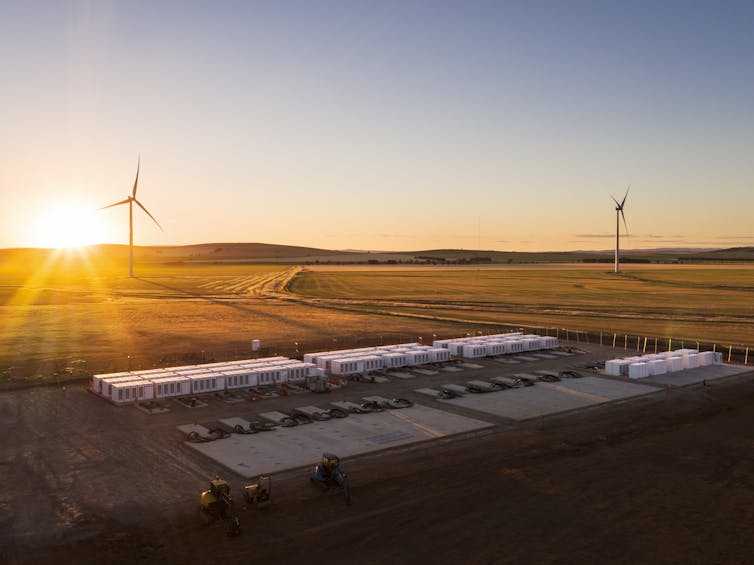
South Australia’s famous grid-scale Tesla battery is being expanded. And the New South Wales government’s pumped hydro plan shows how by 2040, the state could get 89% of its power from solar and wind, backed by pumped hydro storage.
In Australia on Easter Saturday this year, renewables supplied 50% of the national electricity market, which serves the vast majority of the population.
Countries such as New Zealand and Iceland essentially get all their power from renewables, backed up by storage (predominantly hydro).
And putting aside the federal government’s problematic Snowy 2.0 project, Australia could get all its energy from renewables with small-scale storage.
South Australia’s huge battery storage project is being expanded.Hornsdale Power Reserve
What does the film get right?
Planet of the Humans makes several entirely valid points. Here are a few:
1. We need to deal with population growth
The film observes that population growth is the elephant in the room when it comes to climate change. It says politicians are reluctant to talk about limits to population growth 'because that would be bad for business'.
As one observer in the film says, the people in charge aren’t nervous enough. I agree.
An increasing population means increasing demand for energy and other resources, accelerating climate change.
2. Biomass energy does more harm than good
While the film unfairly criticises the environmental benefits of solar energy, it’s true that some so-called clean technologies are not green at all.
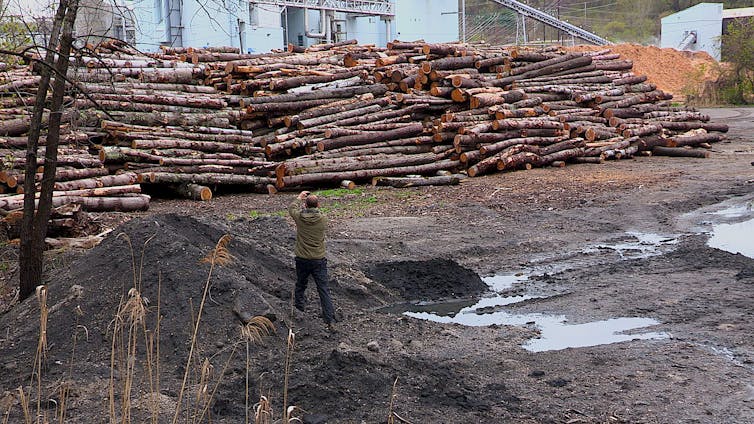
As the film asserts, destroying forests for biomass energy does more harm than good – due to loss of habitat, damage to water systems, and the time taken for some forests to recover from the removal of wood.
Most advocates of cleaner energy systems recognise the limitations of biomass as an energy source.
A still from the film, showing a biomass plant.Planet of the Humans
3. Infinite growth on a finite planet is suicide
The film calculates the sum total of human demands on natural systems as about 1,000 times what it was 200 years ago. It says there are ten times as many people now, each using 100 times the resources, on average.
Experts have repeatedly warned that human demand for resources is damaging the natural systems that all life depends on.
Several other aspects of the film have been savaged by critics – not least its claims about emissions produced by electric cars, which had previously been debunked.
Personal attacks on two prominent US clean energy advocates, Bill McKibben and Al Gore, also detract from the film’s impact.
It’s clear renewable energy has an important role to play in reducing greenhouse gas emissions and slowing climate change. But it won’t solve the fundamental problem: that humans must live within Earth’s natural limits.
Those cheering the film’s criticism of renewables would do well to consider its overriding message.
Correction: A previous version of this article said the claim that solar panels produce less energy than they generate in their lifetime has long been disproved. This has been amended.




 Some of the steep sides of the Quarry, particularly the northern side, are unstable and could collapse in a major rainfall event so rehabilitation works are required. Reshaping of the North Connex fill is proposed, as well as other spoil mounds within the site to allow future development of the quarry into a parkland for community use. These works have to go through a Development Application (DA) process including consideration of public submissions.