
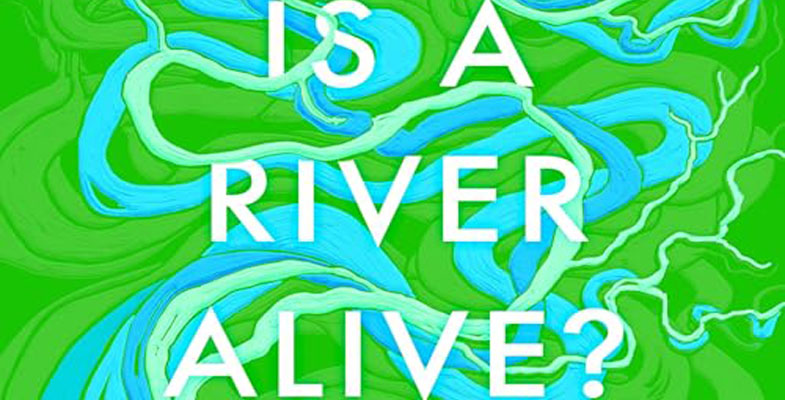
This is a brilliant and thoughtful book and a compelling read, but needs time and concentration – not one to read in snatches while watching TV. It’s non-fiction but with an intensely philosophical view of nature and humankind’s role and effects, both positive and negative. It's structured as three novella-length stories of travels in three distinct corners of the globe and their contrasting river systems – these ‘chapters’ are 70, 73 and 98 pages long respectively, i.e. quite long! But as you read each story it helps greatly to follow its route on Google Earth satellite.
Story 1 follows a climb up to the high Ecuadorian cloud forests to follow a river called Rio Los Cedros (River of Cedars) to its source – Los Cedros is a protected reserve area at more than 2000 metres above sea level. The tale is a fascinating insight into a world of dripping, misty rainforest, and the characters involved in protection of the Andean equatorial forests against mining and other destructive forms of ‘job-creating’ development. Most of these folk are dedicated people facing risk of death from paid armed gangs, and include a woman mycologist who can ‘sense’ the presence of rare fungi off-track, then skip off into the forest and actually find them. As an insight into an area few if any of us will probably ever visit it’s a gem, but it also highlights how little of the natural worlds of the Amazon and Andean terrains are truly protected.
Story 2 couldn’t be more different. It’s set in Chennai, a vast conurbation of 13 million people in Tamil Nadu on India’s east coast. The only thing it has in common with Los Cedros is its equatorial latitude. It features a young man who rose from a sometimes brutal childhood to become a champion local environmental campaigner. The subject is Chennai’s three rivers that start life inland in reasonably pristine condition, but are totally dead of all aquatic life after passing through the Chennai supercity. The interaction between the rivers and the city's waste is total and they stink and are not even fit to be near. If you want to know what the local natural environment is visually, all you will get from Google Earth’s click-on photographs is temple after temple. This could be depressing unless you’re interested in that topic, but liaising with Yuval opens the author to pockets of rich and complex tropical fauna that Yuval regards as his role to nurture and protect: a truly inspirational person.
Story 3 is set in SE Quebec, close to Newfoundland, and couldn’t be more different to the other two settings. But in some ways it’s closer to home here as it bears parallels with the Gordon below Franklin Dam conflict. The river in question is called Mutehekau Shipu and it drains southwards into the Gulf of St Lawrence. It’s sourced and flows through wild and trackless country of forested glaciated Canadian Shield gneiss terrain. The key focal point on the river’s course is 80 km long Lac Magpie, a ribbon-like glacial lake, no wider than around 2 km at any point.
The author is accompanied by a long-standing Canadian friend and three local guides, and they fly with a canoe each, plus supplies, on an Otter float plane to the top end of the lake to begin their two week ‘river voyage’. They paddle southwards via Lac Magpie over several days to the river’s turbulent lake exit, then paddle or are tumbled to the coast on a nail biting passage through multiple rapids, with the river flowing at double its normal seasonal rate.
Having made the comparison with the Franklin, I should qualify that the Mutehekau Shipu is a larger river, though not necessarily more dangerous for water travel. However it’s bad enough, as you can read, and looming over it is yet another dam crisis. The region’s rivers have been peppered with Hydro-Quebec’s dams, usually against the wishes of the locals, especially the Innu First Nations people. A key site is known as The Gorge, and you can easily spot it on Google Earth as a 1 km long band of rough, white water 7 km upstream from the river mouth. This is a key potential dam site that would flood the river for tens of kilometres upstream.
I could waffle on in praise of this brilliant Sunday Times bestseller (also reviewed in New Scientist and the Weekend Australian’s Year’s Best Books) but I can only encourage you to read it for yourselves. Is a river alive? Well you can judge for yourselves, but it’s widely believed by people of all walks of life including those having legal status, and author MacFarlane makes a pretty good case for it.
Reviewed by John Martyn
Author: Robert MacFarlane
Publisher: Penguin Books, 2026
Paperback, 376 pp including glossary, references, index and background info